The ‘Train Your Gaze’ book by Roswell Angier talk about voyeurism in photography. This quote sums up what this means. ‘It is more about a peculiar point of view, based on a longing to possess that which one knows one cannot (and ultimately does not want to) have. The basic condition of the voyeurist scenario is distance, an essential separation between seer and seen. Despite this distance, which is by definition unbridgeable, despite the unrequitable nature of the desire that drives it, the voyeur’s gaze is a privileged one. He usually positions himself in a concealed and protected location: a dark corner, on the other side of a window or keyhole, behind a windshield, any place where his gaze cannot be reciprocated. The last thing he wants is contact with, or recognition by, the person he is looking at. He is the invisible guest.’ ‘Voyeurism is usually assumed to be a male activity. It is associated with pornography, as distinct from the erotic.’ I am going to look into two examples of photographers who use voyeurism in their photographs but in different ways.
There was an exhibition of sexual images taken by British women photographers called ‘What She Wants’. It began as an inquiry into the absence of erotic images of men taken by women. Only a few of the images in the exhibition were voyeuristic, one being by Diane Baylis. The photographer looks through a keyhole at a nude man. The actual subject doesn’t fill much of the frame as the key hole takes up much of the room, this emphasises the private space occupied by the photographer. The number of frames shown at the edge of the negative creates distance, reminding the viewer that it is just a photo. It feels wrong to look at the image as it feels we are invading on this mans private space. Displayed in broad daylight in the public space of the gallery, Baylis wanted people to become aware that other people were around them while they were looking at the large prints.
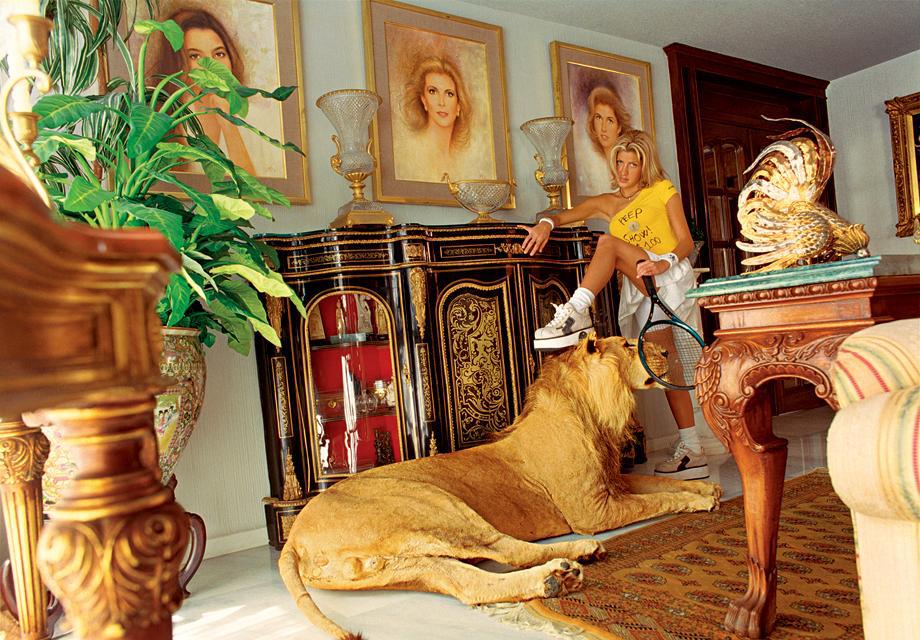
Daniela Rossell deals with the theme of voyeurism in a different way. Her project ‘Ricas Y Famosas’ is of the privileged class in Mexico, in their homes. The subject looks at the camera which means the photographers point of view is not private like in Baylis’ work. ‘Rossell’s subjects strip away the voyeurs cloak of safety. Beyond merely acknowledging or accepting the intrusion of the camera in their own world, they challenge us with their own gaze’. This is complete opposite to Baylis’ work as in hers we feel unseen, as said in the beginning, ‘the invisible guest’. In Rossell’s work the subject is very much aware. Her work might just seem like environmental portraits, but the relationship to voyeurism is complex. There is no secret position of the photographer but it doesn’t seem a coincidence that the subject wears a top saying “Peep Show! $1.00”. What makes it voyeuristic is the distance between us and the subject. As Angier says, ‘she may as well be on the other side of a locked window. She is completely out of reach.’
Voyeurism in relation to my work is similar. The window gives the viewer the secret view like in Baylis’ work. We feel like we are intruding in this persons personal space. This works well, right now you are not meant to be visiting other peoples house. Voyeurism seems wrong, you are looking at something that you don’t feel like you should. This links with the fact that currently we are not allowed to visit people and I am somewhat invading in peoples safe space, again the window giving me and the viewer, that privacy.
 Lucy Davis